At its world premiere on Thursday at the film festival, Payal Kapadia’s All We Imagine As Light—the first Indian film in the Cannes competition in thirty years—made quite a stir and impressed viewers around the globe.
The film received one of the longest standing ovations of this year’s film festival, lasting eight minutes, after its premiere.
All We Imagine As Light dominating critics The picture scripted history at the festival and puts Payal in the running for the coveted Palme d’Or. In addition to being the first Indian production in the competition in thirty years, Deadline claims that Payal is the first female Indian director to have a film screened in the Cannes competition.
Advertisement
“India produces a great deal of excellent films. Not only does each state have its own film industry, led by incredibly talented directors, but not only Bollywood. Payal expressed her excitement and happiness.
that her picture was chosen to Deadline. “I hope that after this we won’t have to wait another 30 years,” she said. We weren’t prepared for it, and it’s an honour because there are so many directors in the category who I find truly inspiring.
This year, Payal faces off against Jacques Audiard, Yorgos Lanthimos, Paul Schrader, David Cronenberg, and Jia Zhangke.
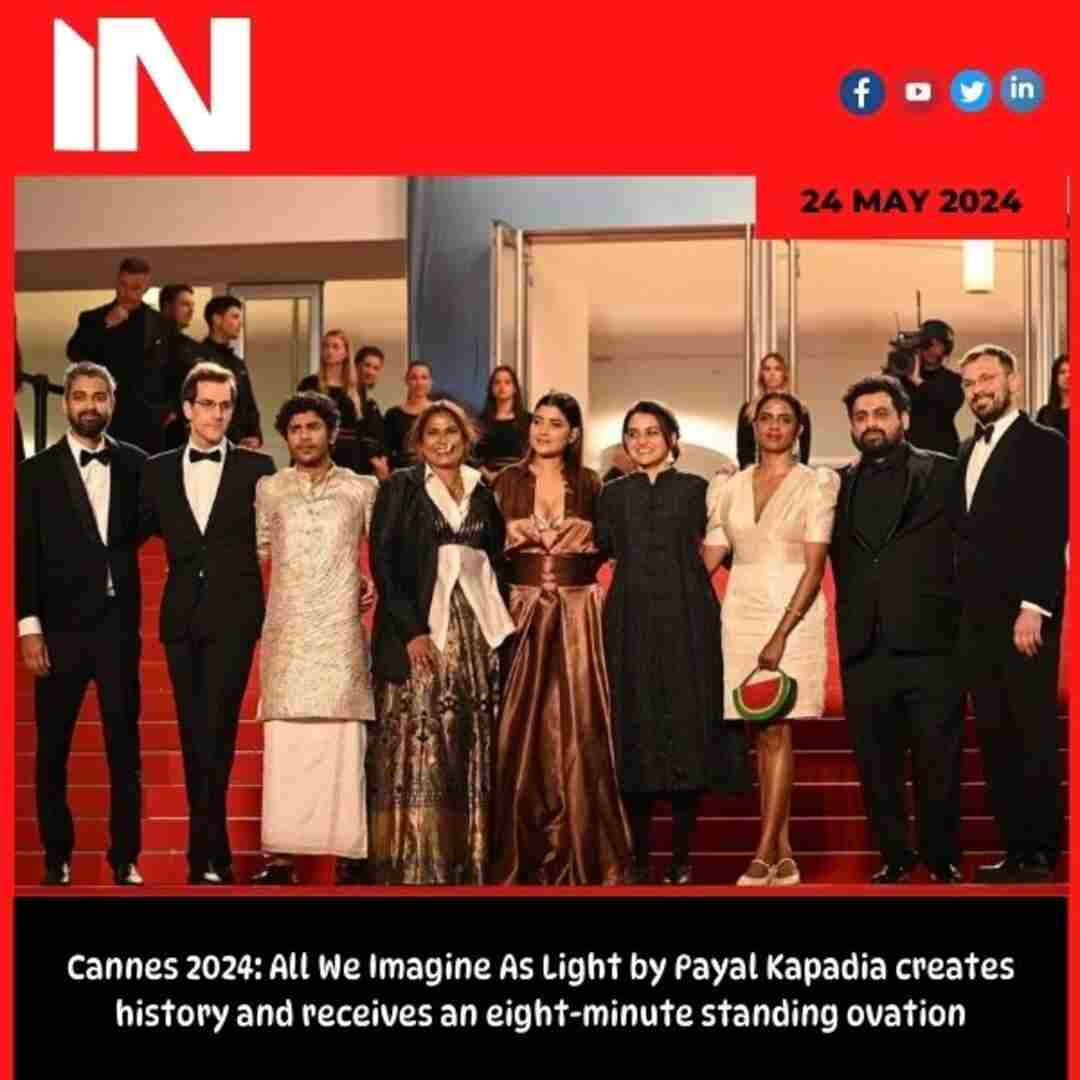
Dancing their path to success The movie’s cast and crew were beaming on the red carpet prior to leaving for the premiere.
On the Palais stairs, the entire team exuded joy and even danced their way up to the theatre. On the red carpet, the cast was all smiles, making a lot of funny poses and grabbing everyone’s attention.
Kani Kusruti, Divya Prabha, Chhaya Kadam, and Hridhu Haroon are among the actors in the movie.
Payal feels honoured that she has the opportunity to create history at the film festival and demonstrate to the world that Indian cinema is much more diverse than Bollywood.
preliminary evaluations After the screening, the movie is receiving excellent reviews. According to Sophie Monk-Kaufman of IndieWire, “This casual everyday vignette is brimming with a sensuality (the rain, the clothes, the food, the women) that people don’t tend to notice when caught up in the rhythm of life,” the film is “gorgeous and absorbing,” according to one review. Realising just how complete these moments are requires a snapshot taken by an outside photographer.
Variety referred to it as a “glowing portrait of urban connection and unexpected sisterhood,” while The Guardian described it as a “dreamlike and gentle modern Mumbai tale that is a triumph.”
Advertisement
Learn more about All We Imagine As Light A nurse named Prabha (played by Kani Kusruti) receives an unexpected present from her long-estranged husband in the Indo-French film All We Imagine As Light. Meanwhile, Anu, her flatmate and younger companion (played by Divya Prabha), is searching for a peaceful place to spend time with her partner. At that point, the two women make the decision to drive to a beach resort where they can freely pursue their aspirations.
Payal makes her feature debut in the movie. A Night of Knowing Nothing, the documentary she did before, won the Golden Eye prize at the Cannes film festival a few years ago.
Cannes 2024: Payal Kapadia’s All We Imagine As Light Makes History with an Eight-Minute Standing Ovation
At the Cannes Film Festival 2024, Indian filmmaker Payal Kapadia made history with her groundbreaking film All We Imagine As Light. The film received a stellar reception, earning an eight-minute standing ovation from the audience — a rare and powerful acknowledgment of her talent and the film’s powerful storytelling.
Advertisement
The film, which explores themes of human connection, emotional depth, and the complexities of life, captivated festival-goers with its unique narrative and stunning visuals. Kapadia’s evocative direction and cinematic style have garnered significant praise, further solidifying her place in the global film industry.
The standing ovation at Cannes is a testament to the film’s emotional depth and the universal themes it tackles. Many critics and attendees expressed their admiration for Kapadia’s ability to weave complex, thought-provoking narratives in such an innovative and compelling way. The film’s exploration of light as both a literal and metaphorical element resonated deeply with audiences, who were moved by the powerful emotions it stirred.
This accomplishment marks a major milestone in Kapadia’s career, as her film continues to draw attention at one of the world’s most prestigious film festivals. All We Imagine As Light has not only received critical acclaim but also put Indian cinema in the global spotlight, with Payal Kapadia being hailed as one of the most promising filmmakers of her generation.
Ali Fazal is now a global giant, but his rise was fraught with danger. Before becoming the renowned, muscle-bound, gun-toting Guddu Pandit of Mirzapur, he faced a horrible crossroads. He was a rising star in Indian cinema, having previously charmed audiences with sweet, romantic, and Hollywood roles. Then, a dark, gritty script appeared on his desk. It was violent, raw, and utterly unprecedented in Indian streaming. The actor reportedly admitted that he was struck by extreme anxiety before signing the contract. The apprehension sprang not only from the prospect of playing a merciless mobster, but also from heated, frightening warnings from industry insiders.
Table of Contents
The Ominous Warnings From Bollywood Insiders
When Ali Fazal first began discussing the role of Guddu Pandit, his industry colleagues were overwhelmingly unfavourable. Several filmmakers and instructors advised him against entering the gloomy realm of Mirzapur. OTT platforms in India were still in their early stages at the time. The established conventions of Bollywood mandated that a starring male should remain on the silver screen. Insiders warned him that producing a web series would be a major setback for his career. They cautioned him that portraying a foul-mouthed, violent character would forever damage his romantic hero image.
Gripped By Terror and Deep Self-Doubt
The actor was under intense psychological pressure. “I was scared at that time,” Ali Fazal confessed bluntly in a recent interview. He was scared that he was making a huge mistake. The character’s extreme ferocity necessitated a comprehensive physical and emotional redesign. He questioned if he could carry off such a threat without losing his current fanbase. The fear of failure loomed huge, prompting him to mistrust his artistic inclinations. Every piece of advise he received told him to abandon the project, leaving him feeling incredibly isolated.
Shattering the Traditional Hero Stereotype
Despite his enormous apprehension, something deep within Ali Fazal compelled him to take the plunge. He understood that the world of storytelling was changing rapidly. He chose to buck the traditional thinking of Bollywood hitmakers, who preferred safe, formulaic films. Stepping into Guddu Pandit’s shoes required him to entirely abandon his vanity. He gave in his elegant, clean-cut appearance for bulked-up muscles, a shaved head, and a limp. It was a violent rejection of the traditional hero stereotype that had held back Indian actors for decades.
Advertisement
A Risk That Rewrote Indian Streaming History
The gambit came off in an unexpected way, surprising even his sharpest critics. Mirzapur’s release was not only successful; it also became a cultural phenomenon. Ali’s scary yet extremely empathic portrayal of a youngster trapped into a criminal life gripped audiences right away. The very filmmakers who had cautioned him away were now screaming his praises. His performance demonstrated that Indian audiences are hungry for nuanced, flawed individuals. He not only saved his career by embracing his innermost anxieties, but he also revolutionised what it means to be a celebrity in the digital age.
Embracing The Fear To Find Greatness
Looking back, Ali Fazal sees the moment of tremendous dread as a crucial trigger for his development. The event taught him that the most rewarding artistic successes are frequently hidden behind our worst fears. If he had followed the cautious, conservative recommendations of the industry elite, the world would not have witnessed Guddu Pandit’s brilliance. His journey serves as a striking example of trusting one’s creative intuition above industry gossip. For Ali, fear was no longer a call to retreat, but rather a clear indication that he was about to create something truly special.





.png "Four years after her divorce, did Samantha Ruth Prabhu get rid of her tattoo with the Naga Chaitanya link? Supporters are persuaded")