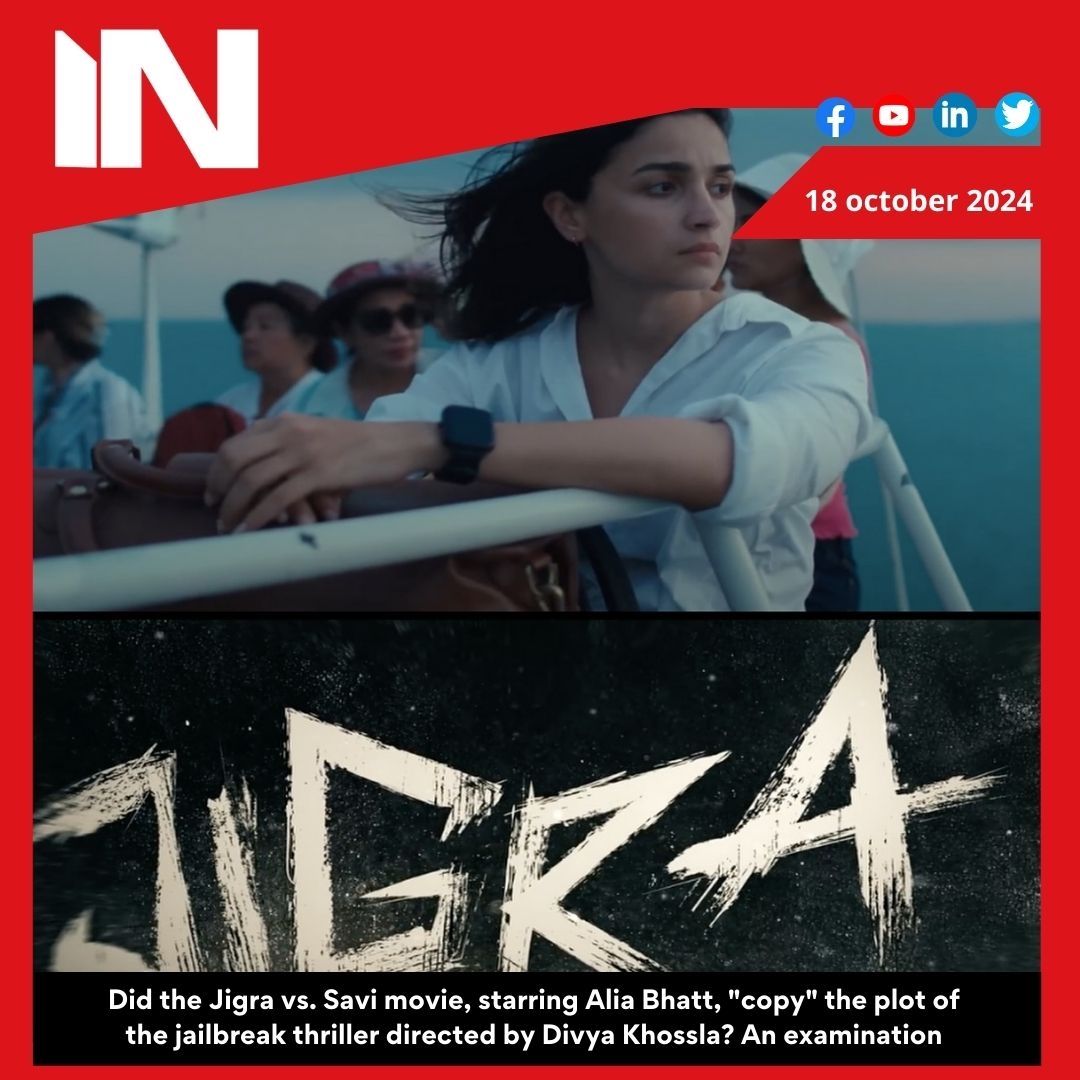
Alia Bhatt’s Jigra and Divya Khossla’s Savi are both films based on women who lead daring jailbreaks in a foreign country to free a loved one.
Vasan Bala’s Jigra was released in theatres last week. The Alia Bhatt and Vedang Raina-starrer polarised audiences and critics alike, with many raving about the film and others calling it less than the sum of its parts. The box office numbers were less than promising to begin with. In the middle of it all, Divya Khossla accused Alia Bhatt of buying tickets herself and inflating box office figures. (Also read: Did Karan Johar call Divya Khossla Kumar ‘a fool’ after her dig at Alia Bhatt’s Jigra?)
As jaws dropped and allegations and name-calling ensued, many wondered why Divya Khossla had decided to open up a front against Jigra. To many, the answer was the actor’s most recent release – Savi. The film is about a woman who must join hands with a middle-aged man to help free a loved one from a foreign prison in a daring jailbreak. Many felt that Divya – and a few viewers too – felt that Jigra (also a film about a woman joining hands with a middle-aged man to help free a loved one from a foreign prison in a daring jailbreak) had ripped Savi off. But is that truly the case?
Jigra vs Savi: The plot and the rip-off allegations
Savi, directed by Abhinay Deo, is the story of the titular Savitri (played by Divya), a simple housewife in Liverpool, whose life is turned upside down when her husband is arrested for the murder of his boss. As legal avenues shut down, Savi enlists an ex-con (Anil Kapoor) to help her plan a daring jailbreak. While the concept may look similar to Jigra, which sees Alia’s Satya travel to a fictitious Southeast Asian country to free her brother, the two films actually differ in several ways. Jigra is constructed like a thriller with an emotional build-up behind it. It takes time to build that brother-sister bond before all hell breaks loose. On the other hand, Savi throws us head first into the action in the first scene itself. Both are interesting choices.
The eerie similarities
But there are similarities, quite a few of them. Both films are led by women for whom morality is not a question. The end goal is freeing their loved ones, no matter who gets hurt in the process. Satya begins with that mindset while Savi arrives there over time. Her arc is more defined. The guardian angel they get in the foreign land is a middle-aged guy with a dark past. Anil Kapoor’s Joydeep is an ex-con who broke out of prison eleven times. Similarly, Manoj Pahwa’s Bhatia is a former gang leader who is now retired and has his own son locked up too. There are times when the similarities appear too similar to be coincidental. But it could all be down to the films using familiar tropes, something that Gumrah did way back in 1993.
Savi vs Jigra: The themes
Where Savi and Jigra diverge is their handling of the conflict and how these two characters attain their similar goals. Savi is an emotional story with elements of thrill. Jigra is the other way around. Savi is smoother in its handling and shift of tones, while Jigra is more smartly packaged and slickly made. Jigra’s jailbreak is more intricate and complex. The film spends a lot of time and energy on the plan. Savi coasts through it, focusing largely on Savi’s inner turmoil and journey. Both films, however, have glaring plot holes in many places.
The characters of Satya and Savi are poles apart. The former is a hot-headed resourceful professional prone to violence. Sure, she punches above her weight, but the film sets her up as a hero figure. The references to Bachchan and her demeanour sell that quite smoothly. On the other hand, Savii’s the story of the underdog – the diminutive housewife who knows nothing of violence and darkness. Here, the character has to earn her badassery. She doesn’t already have it.
To sum it up, Savi and Jigra are similar films with a core idea that is quite novel and yet routine. The plots may be similar but are different enough to avoid the ‘copied’ jibe. Divya Khossla may believe she has reason to be aggrieved, but the reality is that Bollywood has, time and again, found itself films on similar themes releasing close to each other. And if we can find space for three Bhagat Singh biopics, all releasing in one month, two female-led films on jailbreak can be accommodated as well.
Group Media Publications
Entertainment News Platforms – anyflix.in
Construction Infrastructure and Mining News Platform – https://cimreviews.com/
General News Platform – https://ihtlive.com/
Podcast Platforms – https://anyfm.in






.png "Four years after her divorce, did Samantha Ruth Prabhu get rid of her tattoo with the Naga Chaitanya link? Supporters are persuaded")