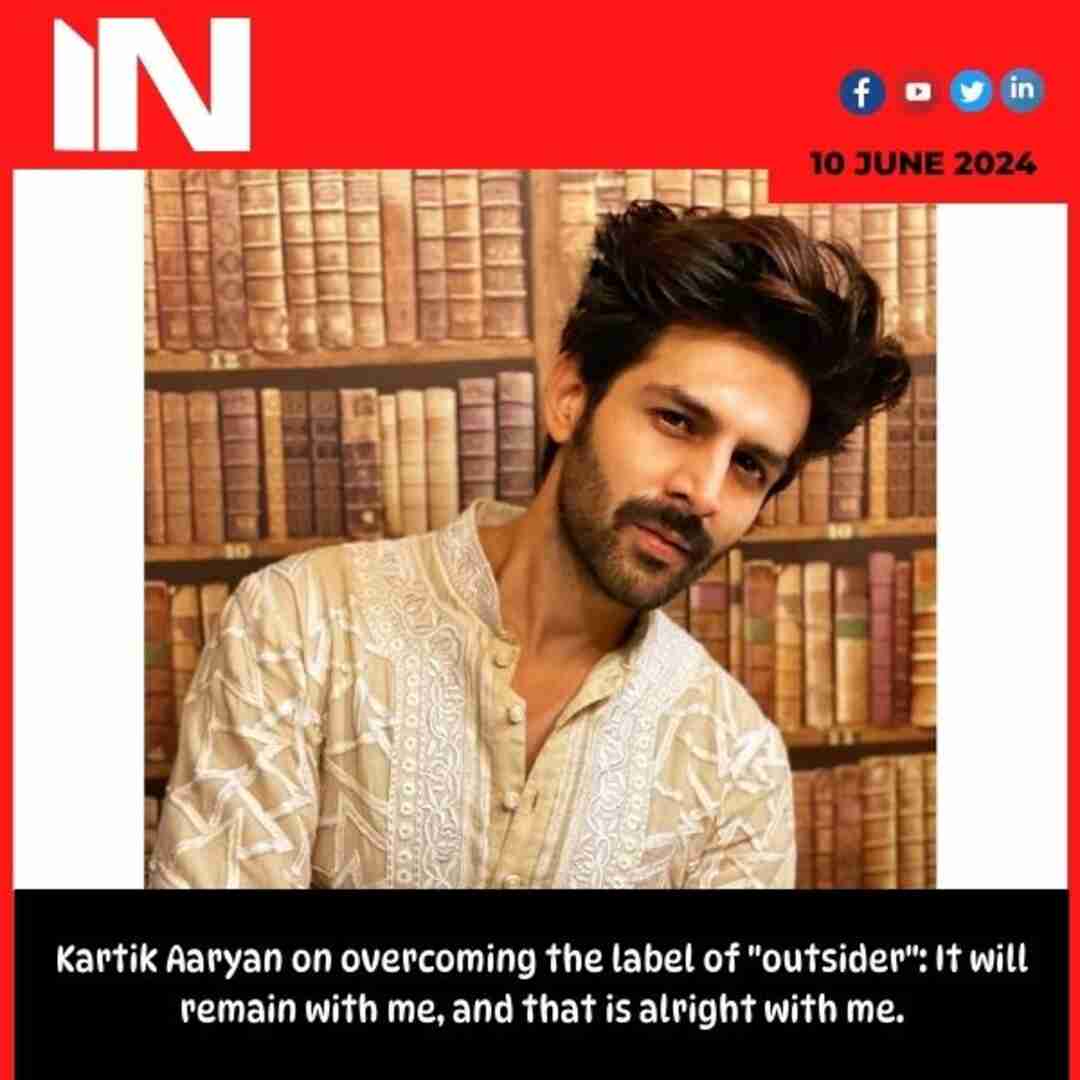
Actor Kartik Aaryan entered Bollywood 13 years ago with no film industry restrictions and quickly established himself as a valuable performer and box office draw. Nevertheless, the actor doesn’t mind that he is still labelled as an outsider.
He claims that his motivation to push himself further comes from the knowledge that he might not receive another chance.
Advertisement
After making his screen debut in 2011 in Luv Ranjan’s Pyaar Ka Punchnama, Kartik went on to establish himself in the business with roles in Sonu Ke Titu Ki Sweety, Pyaar Ka Punchnama 2, Luka Chuppi, Bhool Bhulaiyaa 2, and Satyaprem Ki Katha. He is currently waiting for Chandu Champion, his film, to be released.
Kartik, who started out as an outsider with no contacts in the business, has gone a long way. The actor acknowledges his gratitude for making it this far and vows to never forget where he began.
“It is what it is,” he says, candidly discussing how the label of “outsider” has followed him down the years.
“I didn’t know anyone here when I first started my adventure in Bollywood. And things remain the same as they have been up until now. For me, everything is the same. There are Fridays that work and Fridays that don’t. However, it is still true that I have never been an insider, he continues.
As he acknowledges, “It is a mindset which is going to stay with me,” he is aware that he arrived in the glitzy town from the “outside world.” As of right now, I think that any Friday can also be the last Friday. This is the reverberation that never stops in my head. Ke kahin mera pack up na ho jaaye”.
Perhaps at some point in the future, I (realise) may not receive a second or third chance, and I have nowhere else to go.
“That’s the reason why I’m frequently asked if I’m an outsider. I am more outspoken about that path because I am proud of it. It’s also a positive thing. He says with pride, “Whoever has succeeded on his own ought to be really proud of it.
Advertisement
Regarding not assuming success for granted It is impossible to take success for granted. In fact, there are moments when I even hesitate to use the word “success.” It might be referred to as nazar lag jaati hai, or superstition. All I’m doing is my job. I’m hoping that people will keep loving me and being interested in what I’m doing. “I won’t get attached to flops or hits; I’ll keep working the way I’ve been working,” he emphasises.
“Working on the movie has been incredibly fulfilling. Playing Murlikant Petkar was a challenging yet enjoyable exercise that satisfied my creative needs. Having a movie like this is a unique chance. I was ecstatic to be able to work on the project. I had a terrific time despite the agony, injuries, and sacrifices,” Kartik says, grinning broadly at the news that the movie is set for a large screen premiere.
The narrative of a sportsman’s tenacity and resolve is told by Chandu Champion. The movie is based on the life of India’s first gold medallist in the Paralympic Games for freestyle swimming, Murlikant Petkar.
It will be revealed that Kartik suffered a significant physical metamorphosis in order to convey the life of Murlikant to Chandu. June 14 is the scheduled release date of the movie. Kabir Khan and Sajid Nadiadwala are co-producing the movie.
Ali Fazal is now a global giant, but his rise was fraught with danger. Before becoming the renowned, muscle-bound, gun-toting Guddu Pandit of Mirzapur, he faced a horrible crossroads. He was a rising star in Indian cinema, having previously charmed audiences with sweet, romantic, and Hollywood roles. Then, a dark, gritty script appeared on his desk. It was violent, raw, and utterly unprecedented in Indian streaming. The actor reportedly admitted that he was struck by extreme anxiety before signing the contract. The apprehension sprang not only from the prospect of playing a merciless mobster, but also from heated, frightening warnings from industry insiders.
Table of Contents
The Ominous Warnings From Bollywood Insiders
When Ali Fazal first began discussing the role of Guddu Pandit, his industry colleagues were overwhelmingly unfavourable. Several filmmakers and instructors advised him against entering the gloomy realm of Mirzapur. OTT platforms in India were still in their early stages at the time. The established conventions of Bollywood mandated that a starring male should remain on the silver screen. Insiders warned him that producing a web series would be a major setback for his career. They cautioned him that portraying a foul-mouthed, violent character would forever damage his romantic hero image.
Gripped By Terror and Deep Self-Doubt
The actor was under intense psychological pressure. “I was scared at that time,” Ali Fazal confessed bluntly in a recent interview. He was scared that he was making a huge mistake. The character’s extreme ferocity necessitated a comprehensive physical and emotional redesign. He questioned if he could carry off such a threat without losing his current fanbase. The fear of failure loomed huge, prompting him to mistrust his artistic inclinations. Every piece of advise he received told him to abandon the project, leaving him feeling incredibly isolated.
Shattering the Traditional Hero Stereotype
Despite his enormous apprehension, something deep within Ali Fazal compelled him to take the plunge. He understood that the world of storytelling was changing rapidly. He chose to buck the traditional thinking of Bollywood hitmakers, who preferred safe, formulaic films. Stepping into Guddu Pandit’s shoes required him to entirely abandon his vanity. He gave in his elegant, clean-cut appearance for bulked-up muscles, a shaved head, and a limp. It was a violent rejection of the traditional hero stereotype that had held back Indian actors for decades.
Advertisement
A Risk That Rewrote Indian Streaming History
The gambit came off in an unexpected way, surprising even his sharpest critics. Mirzapur’s release was not only successful; it also became a cultural phenomenon. Ali’s scary yet extremely empathic portrayal of a youngster trapped into a criminal life gripped audiences right away. The very filmmakers who had cautioned him away were now screaming his praises. His performance demonstrated that Indian audiences are hungry for nuanced, flawed individuals. He not only saved his career by embracing his innermost anxieties, but he also revolutionised what it means to be a celebrity in the digital age.
Embracing The Fear To Find Greatness
Looking back, Ali Fazal sees the moment of tremendous dread as a crucial trigger for his development. The event taught him that the most rewarding artistic successes are frequently hidden behind our worst fears. If he had followed the cautious, conservative recommendations of the industry elite, the world would not have witnessed Guddu Pandit’s brilliance. His journey serves as a striking example of trusting one’s creative intuition above industry gossip. For Ali, fear was no longer a call to retreat, but rather a clear indication that he was about to create something truly special.





.png "Four years after her divorce, did Samantha Ruth Prabhu get rid of her tattoo with the Naga Chaitanya link? Supporters are persuaded")