Connect with us

Bollywood

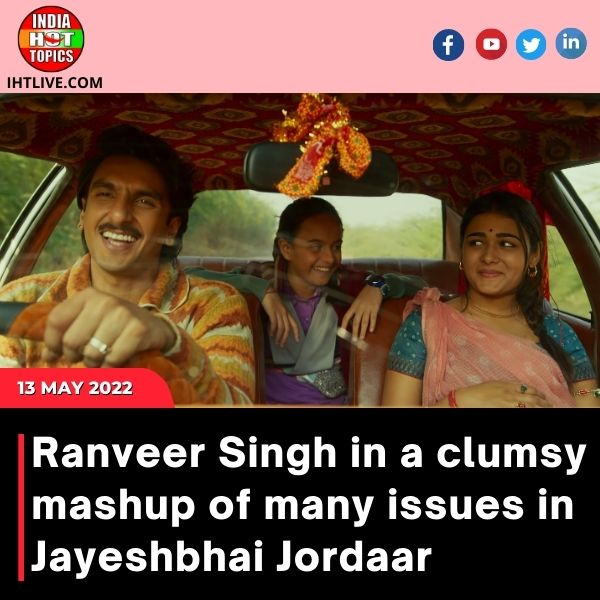
Ranveer Singh in a clumsy mashup of many issues in Jayeshbhai Jordaar

Published

on

Ranveer Singh in a clumsy mashup of many issues in Jayeshbhai Jordaar

Just before Jayeshbhai introduces us to his family, he makes a rather silly analogy between scientists curious about Mars and his parents curious about his child’s gender. What do a planet and a woman’s womb have in common? They’re both round (gol), after all. To set the tone and expectations, some Gujju humour. In the first scene, director Divyang Thakkar states that “pre-natal sex determination testing is a punishable offence.” And Jayeshbhai Jordaar’s entire premise revolves around this.

In the titular role, Ranveer Singh has a lot on his plate: end female foeticide, end patriarchy, empower women, save his unborn daughter’s life, and rebel against his family.

One thing I didn’t get until the end was why the movie was set in Gujarat. Why not some small town in Rajasthan or Uttar Pradesh, where such practises are common? Was it the Gujarati flavour and the director’s decision to give Ranveer a rather amusing makeover and character that he thought would appeal to the audience? Is Jayeshbhai just a vehicle for Ranveer to test his acting abilities? Let me tell you, even in this otherwise’restrained’ role, he goes overboard far more frequently than you’d expect.

Advertisement

The film opens with Jayeshbhai Patel (Ranveer Singh) and his wife Mudra Patel (Shalini Pandey) under extreme pressure from his parents, played by Boman Irani as the traditional Gujarati sarpanch and Ratna (Jia Vaidya). After learning that Mudra is pregnant again with a girl child after six miscarriages, Jayeshbhai devises a cunning plan to flee. The film is primarily a cat and mouse chase between the couple and the men of their village. There are a few predictable twists, some funny scenes, a few jokes that fall flat, and, of course, a lot of dramatic dialogue that doesn’t help the film.

Jayeshbhai Jordaar intends to send out a strong message of “beti bachao” (save the girl child), but this isn’t something new. Na Aana Is Des Laado was a TV show that aired for over three years and made quite an impression without resorting to gratuitous humour. A parallel subplot in Jayeshbhai Jordaar concerns a town in Haryana called Laadopur, which is full of wrestlers led by Puneet Issar, and where the arrival of a girl child is celebrated and rejoiced. They play an important role in the plot of the film and immediately reminded me of this TV show.

Director Divyang Thakkar, who also wrote the screenplay, loses track of what he wants to achieve with the film in the middle. He mashes up a lot of things, and they start to look like a clumsy mashup that can’t stay focused. Both the story and the screenplay are extremely lazy in the first half of the film. The film only picks up in the second half, and you’re left wondering, “OK, what’s next?” Namrata Rao deserves credit for crisp editing and completing it in a manageable two-hour runtime.

Ranveer Singh is bursting with energy yet again, though I was hoping for a more understated performance in this one given the subject matter. That balance of comedic, emotional, and mature acts works for me. Even though he looked ridiculous doing those steps that remind you of Jethalal from Tarak Mehta Ka Oolta Chasma, watching him dance on the track Firecracker in the end credits was a treat. Shalini Pandey, who we saw in the Telugu film Arjun Reddy (which was later remade in Hindi as Kabir Singh) as a demure and timid lover, is impressive in parts. Unfortunately, her character arc never progresses beyond a certain point. Her performance opportunities are limited, and you’d like to see a lot more of her, but that never happens. Both Boman and Ratna play their parts brilliantly, and this is where experience comes into play. In the midst of it all, child actor Jai Vaidya steals the show as Ranveer and Shalini’s onscreen daughter. Her wit, confidence, spontaneity, expressions, and everything else about her in the film is spot on.

Advertisement

Overall, Jayeshbhai Jordaar is a good watch, but does it linger in your mind and make you think? I doubt. At the very least, I won’t be thinking about it after I finish this review. Keep an eye out for this young actor and another loud performance from Ranveer.

Jordaar, Jayeshbhai
Divyang Thakkar directs.
Ranveer Singh, Shalini Pandey, Boman Irani, and Ratna Pathak Shah star in the film.

Advertisement

Bollywood News

Ali Fazal’s Heartbreaking Fear: The Mirzapur Risk That Almost Ruined Him

Published

on

Ali Fazal's Shocking Powerful Mirzapur Revelation

Ali Fazal is now a global giant, but his rise was fraught with danger. Before becoming the renowned, muscle-bound, gun-toting Guddu Pandit of Mirzapur, he faced a horrible crossroads. He was a rising star in Indian cinema, having previously charmed audiences with sweet, romantic, and Hollywood roles. Then, a dark, gritty script appeared on his desk. It was violent, raw, and utterly unprecedented in Indian streaming. The actor reportedly admitted that he was struck by extreme anxiety before signing the contract. The apprehension sprang not only from the prospect of playing a merciless mobster, but also from heated, frightening warnings from industry insiders.


The Ominous Warnings From Bollywood Insiders

When Ali Fazal first began discussing the role of Guddu Pandit, his industry colleagues were overwhelmingly unfavourable. Several filmmakers and instructors advised him against entering the gloomy realm of Mirzapur. OTT platforms in India were still in their early stages at the time. The established conventions of Bollywood mandated that a starring male should remain on the silver screen. Insiders warned him that producing a web series would be a major setback for his career. They cautioned him that portraying a foul-mouthed, violent character would forever damage his romantic hero image.


Gripped By Terror and Deep Self-Doubt

The actor was under intense psychological pressure. “I was scared at that time,” Ali Fazal confessed bluntly in a recent interview. He was scared that he was making a huge mistake. The character’s extreme ferocity necessitated a comprehensive physical and emotional redesign. He questioned if he could carry off such a threat without losing his current fanbase. The fear of failure loomed huge, prompting him to mistrust his artistic inclinations. Every piece of advise he received told him to abandon the project, leaving him feeling incredibly isolated.


Shattering the Traditional Hero Stereotype

Despite his enormous apprehension, something deep within Ali Fazal compelled him to take the plunge. He understood that the world of storytelling was changing rapidly. He chose to buck the traditional thinking of Bollywood hitmakers, who preferred safe, formulaic films. Stepping into Guddu Pandit’s shoes required him to entirely abandon his vanity. He gave in his elegant, clean-cut appearance for bulked-up muscles, a shaved head, and a limp. It was a violent rejection of the traditional hero stereotype that had held back Indian actors for decades.

Advertisement

A Risk That Rewrote Indian Streaming History

The gambit came off in an unexpected way, surprising even his sharpest critics. Mirzapur’s release was not only successful; it also became a cultural phenomenon. Ali’s scary yet extremely empathic portrayal of a youngster trapped into a criminal life gripped audiences right away. The very filmmakers who had cautioned him away were now screaming his praises. His performance demonstrated that Indian audiences are hungry for nuanced, flawed individuals. He not only saved his career by embracing his innermost anxieties, but he also revolutionised what it means to be a celebrity in the digital age.


Embracing The Fear To Find Greatness

Looking back, Ali Fazal sees the moment of tremendous dread as a crucial trigger for his development. The event taught him that the most rewarding artistic successes are frequently hidden behind our worst fears. If he had followed the cautious, conservative recommendations of the industry elite, the world would not have witnessed Guddu Pandit’s brilliance. His journey serves as a striking example of trusting one’s creative intuition above industry gossip. For Ali, fear was no longer a call to retreat, but rather a clear indication that he was about to create something truly special.


<< BACK TO TOC

Group Media Publication
Construction, Infrastructure, Mining and Energy
General News Platforms – IHTLive.com
Entertainment News Platforms – https://anyflix.in/
Powered By: Super-fast and reliable streaming is delivered by Bunny CDN.
Explore: https://bunny.net/?ref=i33ljelh4w

Advertisement

Continue Reading
Anyskill-ads

[the_ad id="55117"]

Trending

Copyright © 2021, https://anyflix.in | Email: admin[at]anyflix.tv | Advertising: +919871382863